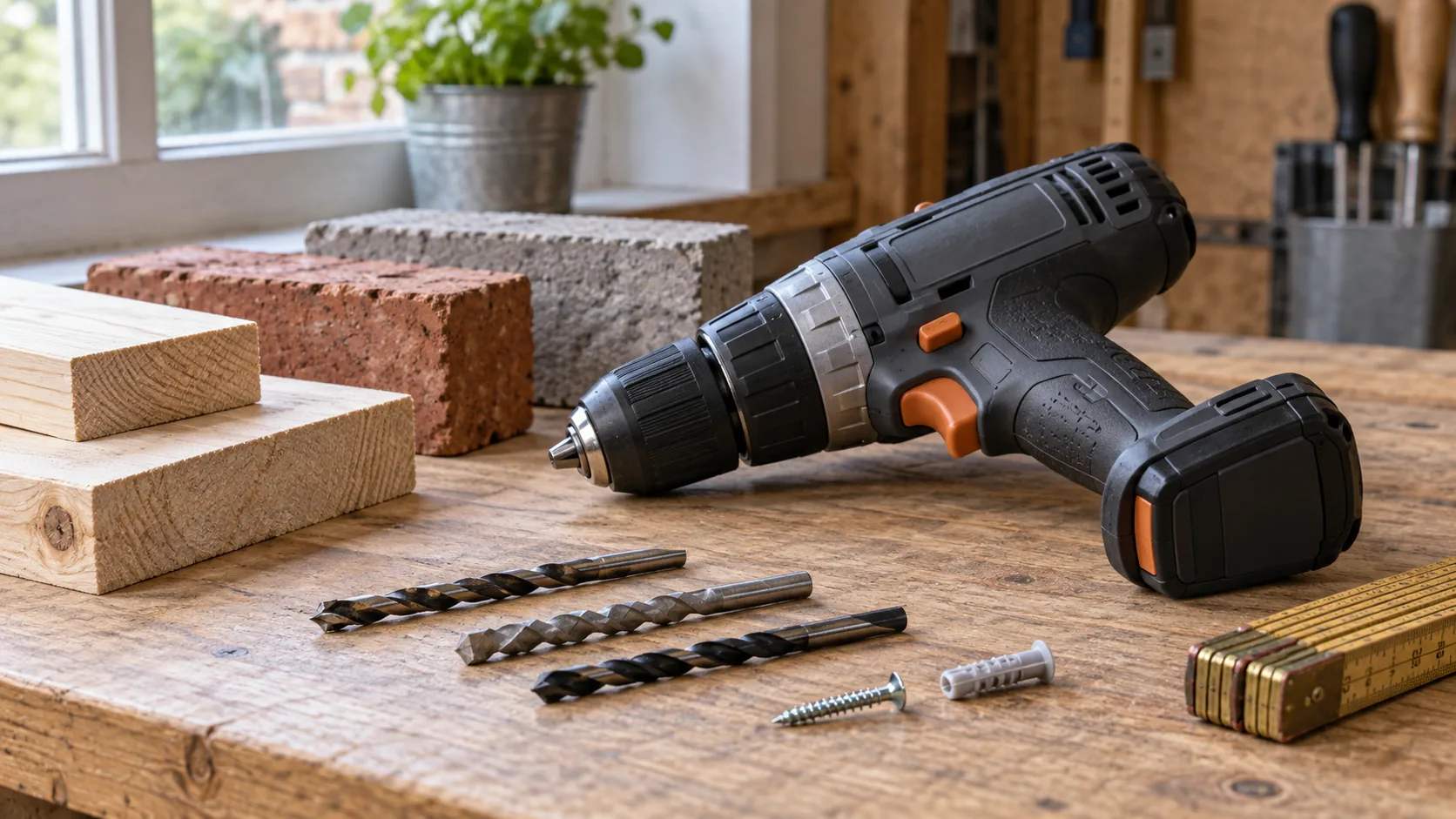
Choose the drill around the holes and screws you actually need to make. A combi drill combines ordinary rotary drilling, screwdriving with a clutch and a hammer setting for suitable masonry. Check the fixing instructions first, then match the bit size and material to the drill's stated capacity. Battery platform and the exact box contents can matter more than a headline torque figure. We compared published UK specifications below; we did not run these drills or measure their performance.
What should you check before comparing models?
Start with the job, bit and power system. For wood or metal, check the bit maker's required speed and the drill's chuck range. For wall fixings, follow the plug maker's hole diameter and the wall material; check that the drill and bit are specified for the material. Use the clutch for screwdriving, then choose a setting on scrap material. A combi drill's hammer mode is not a promise that it suits every hard masonry or concrete task; the exact model manual sets the limits. Our drill-bit size chart converts fractional sizes, while the drill-bit buying guide explains bit types.
Scroll sideways to see all columns on a small screen.
| Decision | Ask this before buying | Why it changes the choice |
|---|---|---|
| Required hole | What diameter, depth and material does the fixing call for? | The bit and material determine whether the drill's stated capacity is relevant. |
| Chuck and bit | Does the chuck accept the bit shank and diameter? | A headline drilling capacity is not the chuck's entire usable range. |
| Battery system | Which batteries and chargers do you already own? | Tool-only and kit versions have different contents; platform compatibility must be checked. |
| Handling | Will you drill overhead, inside cupboards or for long periods? | Weight with the chosen battery and grip can matter as much as a catalogue torque figure. |
| Repeated hard masonry | Is the task beyond the combi drill manual's stated use? | A different tool class may be needed; do not force an unsuitable bit or drill. |
How do three exact UK listings differ?
These are specification examples, not a tested ranking. The named variants show why the model suffix and supplied kit must be checked separately from the tool family. Values from different makers are not a controlled performance comparison.
Scroll sideways to see all columns on a small screen.
| Exact listing rechecked 3 October 2026 | Maker-stated task and tool details | Variant contents to verify |
|---|---|---|
| Bosch Professional GSB 18V-55, 0 601 9H5 303 | 18 V combi, 1.5–13 mm chuck and two gears; Bosch lists drilling in wood, steel and masonry for this model | The named 303 variant lists an L-BOXX and inlay. Do not assume a battery and charger are in this box. |
| Makita DHP482RTJ | 18 V LXT combi with two speed settings and hammer action; Makita publishes separate capacity figures by material and bit type | The RTJ sheet lists two 5.0 Ah LXT batteries, charger and Makpac case. |
| DeWalt DCD796P2-GB | 18 V XR brushless hammer drill driver with two speeds and 15-position torque control | DeWalt lists two 5 Ah XR batteries, a multi-voltage charger and a TSTAK kitbox. |
Bosch's 303 variant and the two named battery kits are not like-for-like retail bundles. Verify the precise suffix and current contents at the retailer before comparing total cost. We have not compared prices. A new UK Amazon offer for the DeWalt DCD796P2-GB kit was verified on 3 October 2026; availability can change. A tool body from one platform should not be assumed to accept another platform's battery or charger.
Does more torque make a better first drill?
No single torque number decides the job. Makers may quote soft, hard or maximum torque under different conditions. A screw can strip or a bit can slip even when a drill has a high published figure. First match the bit and fixing, then use the correct drilling mode, speed and clutch setting from the manual. The Bosch GSB 18V-55 listing, for example, separates 28 Nm soft and 55 Nm hard torque; that does not establish a measured advantage over the other two drills here. For a small screw in softwood, controlled driving can matter more than maximum force.
How should you buy the right kit?
Write down the exact tool and kit code before ordering. Check whether the offer contains a battery, charger, case and side handle if needed. Compare the offered battery voltage and capacity with the maker's platform, and read the warranty and safety instructions for that specific UK variant. If you already own a compatible battery system, a tool-only offer may be simpler; if this is your first cordless tool, a verified kit avoids discovering that the box lacks a charger. Check whether the chuck, bits and wall fixings for your first job are separate purchases.
How did we research these examples?
We rechecked the three linked UK manufacturer sources on 3 October 2026 and compared task, chuck or mode information where published, plus exact kit contents. We also matched DeWalt's DCD796P2-GB kit to Amazon UK ASIN B01L4P0YAK in a browser and confirmed a new UK offer. This is desk research. We did not purchase a drill, drill test holes, time battery life or weigh a working kit. Product variants, offers and manuals can change; read the current instructions and packaging before use. The cover image is an editorial illustration, not a photograph of a tested product.