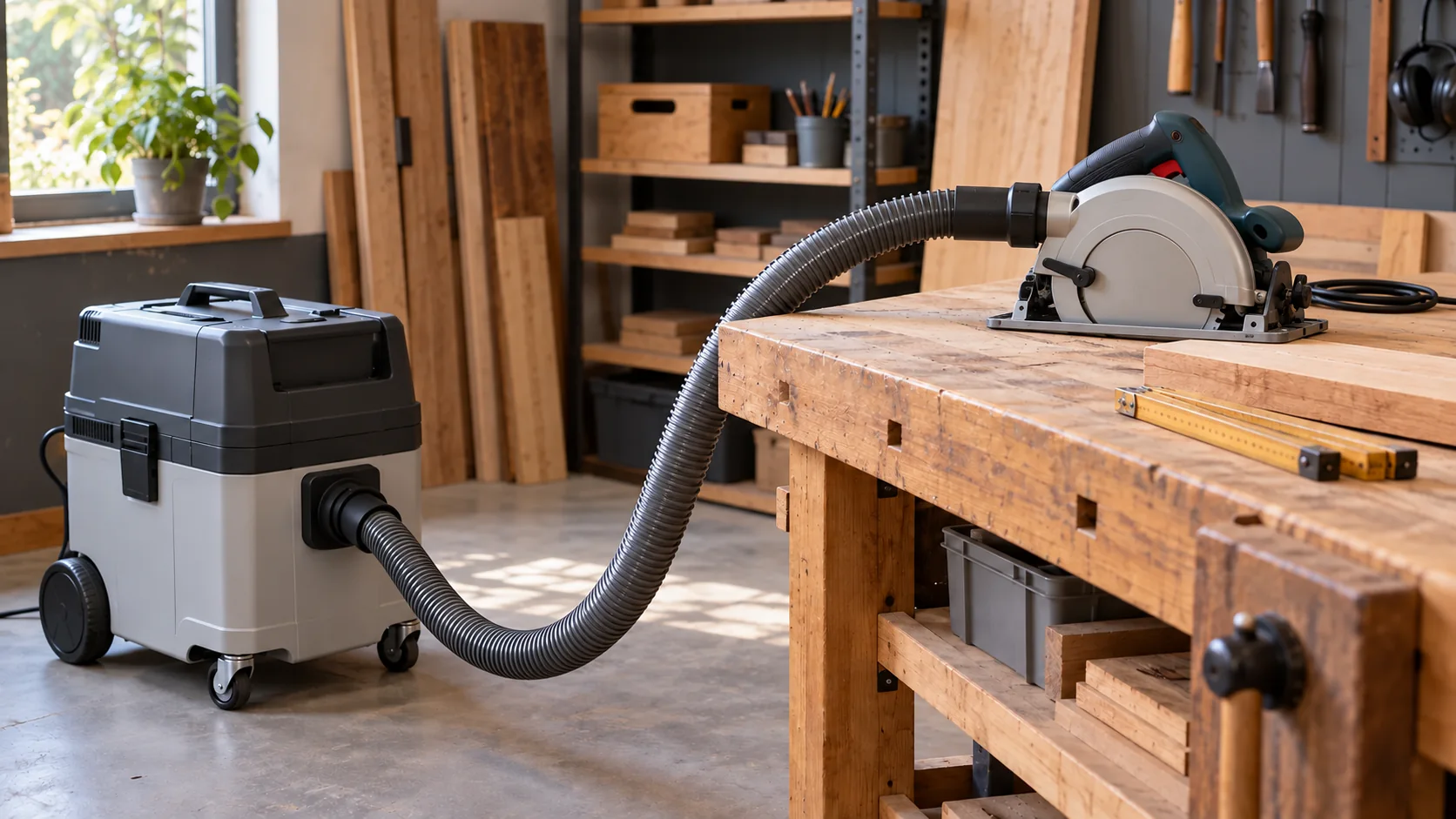
For a small workshop cutting or sanding wood, start with capture at the tool, a sealed hose connection and an extractor suited to wood dust. In its workplace guidance, the UK Health and Safety Executive (HSE) calls for an industrial vacuum that at least meets Class M for cleaning up wood dust, and its construction guidance says to use H or M class extraction on the tool for cutting and sanding. Check the particular tool's extraction requirements and the current extractor manual before buying. This guide compares published specifications; we have not measured either machine's dust capture.
Why does the dust class matter?
HSE says wood dust can cause asthma and that carpenters and joiners are four times more likely to develop it than other UK workers. This is an occupational comparison, not an estimate of risk for an occasional home DIYer; HSE does not give a sample size or time period for the estimate on its wood-dust page. Hardwood dust also carries a cancer risk. The practical buying point is to prevent dust spreading at the source rather than relying on a general-purpose vacuum after the job.
For workers, HSE lists an eight-hour time-weighted workplace exposure limit of 3 mg/m³ for hardwood dust and 5 mg/m³ for softwood dust. The 3 mg/m³ figure applies to the whole mixture when hardwood and softwood dust are mixed. These are workplace limits, not safe thresholds for home DIY or a target a shopper can verify from an extractor's brochure. Exposure should be reduced as low as reasonably practicable. See HSE's limits and control guidance.
HSE's construction guidance for cutting and sanding wood says to select an H or M class on-tool extraction unit, use the right flow rate, make tight connections and use suitable antistatic hoses. It also says respiratory protective equipment with an assigned protection factor of at least 20, such as an FFP3 mask, will be required for most cutting and sanding work, particularly in enclosed spaces. Extraction alone is not a promise that a room is safe. Workplace duties depend on the job and employer. Home users should still follow the tool and extractor manuals and avoid breathing the dust.
Which published M-class models illustrate the choices?
These are specification examples, not a tested ranking. The compact Festool and larger DeWalt demonstrate why tank size is only one decision. Confirm the exact UK variant, voltage, hose and connector before purchase. We have not checked current stock, prices or how well either captures dust on a particular saw.
Scroll sideways to see all columns on a small screen.
| Exact UK listing | Published dust class and format | Relevant maker details | What to confirm |
|---|---|---|---|
| Festool CTM MIDI I, 230 V, item 578326 | M class, compact mobile extractor | Smooth antistatic hose, bayonet connection and manual filter cleaning are described by Festool | Tool-port adapter, bag/filter availability, room for the machine and hose route |
| DeWalt DWV905M-LX | M class, 38 L wet/dry extractor | Maker lists a 32 mm internal-diameter 4.6 m antistatic hose, AIRLOCK connector, remote key fob and fleece bag | Exact supply voltage and plug for the offered variant, connector fit, space and moving weight |
A Class L label, a HEPA filter claim, high motor wattage and a large tank do not by themselves establish that an entire machine meets the M-class specification HSE calls for in its wood-dust workplace guidance. Check the whole extractor's certified class, its bag/filter system and the dust it is approved to collect. Avoid adapting a wet/dry cleaner to hazardous dust without the maker's instructions.
How do you match an extractor to a small workshop?
- List simultaneous machines. A single mobile extractor moved between a saw and sander differs from fixed ducting serving several ports. HSE says the number and type of machines used together should inform the system design.
- Check airflow at the tool. Read the saw or sander manual's extraction-port and flow requirements. Brochure turbine airflow is measured at a different point and does not prove capture at a blade guard or sanding pad.
- Check the whole connection. Measure the actual port and adapter, then compare hose diameter, length and bend route. HSE calls for secure joints without obvious leaks and hoses suitable for wood dust, which it defines as antistatic.
- Plan filter and bag care. Check the maker's cleaning method, replacement filters and how full bags are removed without spreading dust. Keep access to the extractor clear.
- Allow space and noise. Measure where the machine will stand and how the hose reaches each tool without snagging. A larger container may save emptying but takes more floor space.
If you are choosing the saw at the same time, our first circular saw guide covers the saw-side checks. Keep the tool manual's extraction requirements beside the extractor listing; a matching brand name alone does not prove that the hose, adapter and flow are right.
Does extraction really make a measurable difference?
In one industrial multi-blade roof-truss saw retrofit, HSE reports that personal wood-dust sampling fell by approximately 90% after local exhaust ventilation was retrofitted and the dust was further contained with a polymer sheet. That is a case study for one machine and control design, not an expected result from either portable extractor above. HSE also reports separate static samples; those static measurements must not be compared directly with a worker's eight-hour personal exposure limit. The lesson for a small workshop is to design capture around the actual dust source and check that it works, rather than treating a product class as a guaranteed percentage reduction.
How did we research this guide?
We checked the linked HSE pages and the two UK manufacturer listings on 28 September 2026. We selected the models because their published pages identify an M-class machine and show contrasting compact and larger formats. No products were bought or operated for this guide; we have no measured capture, airflow at the tool, noise, longevity or current-price comparison. Recheck the exact variant and maker instructions before purchase. For workplace exposure or respiratory protection decisions, use current HSE guidance and a competent assessment.