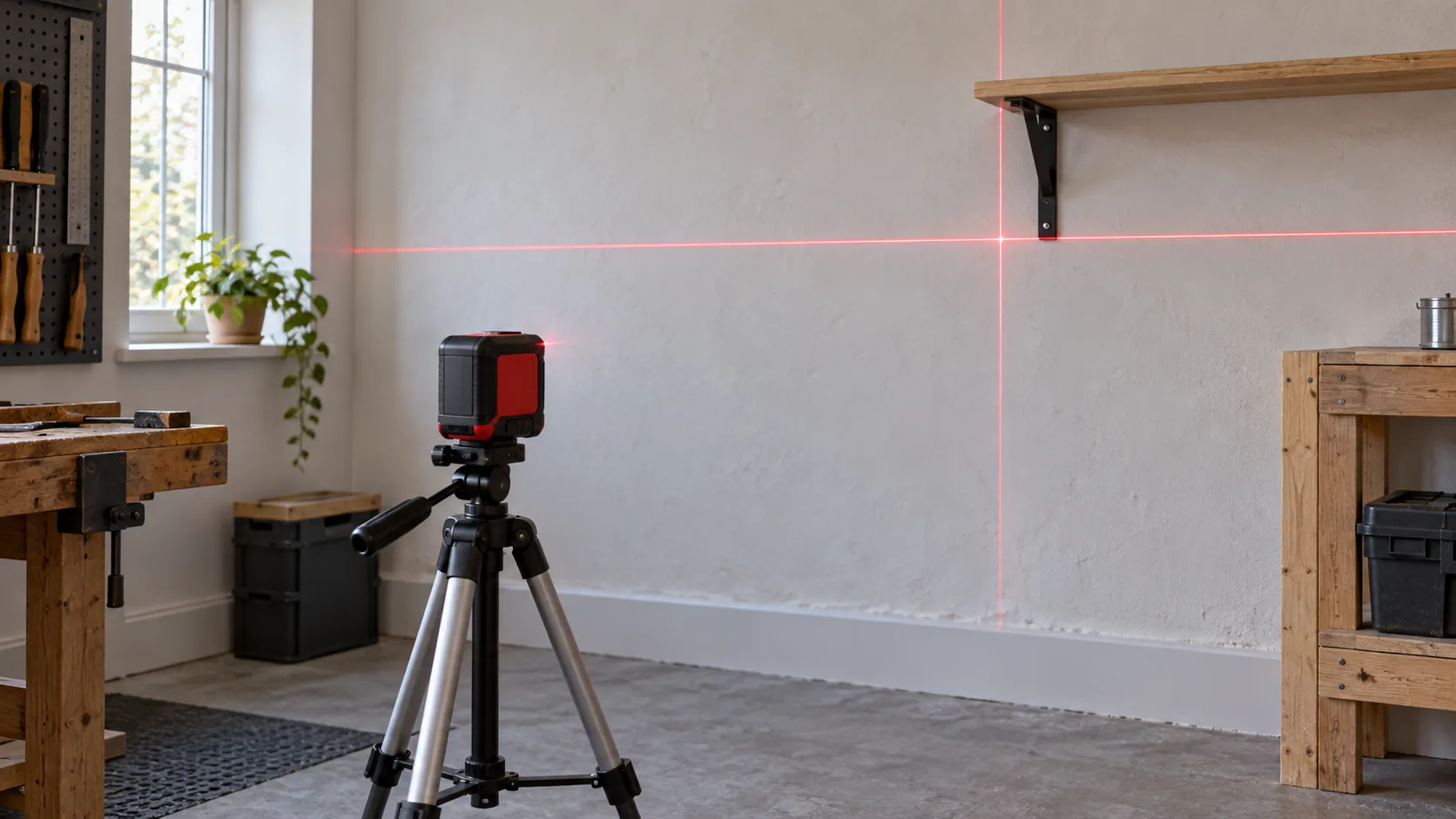
Choose the beam pattern for the job before comparing range or colour. A cross-line laser projects horizontal and vertical lines for shelves, tiles and framing. A combi laser adds plumb points for transferring a position between floor and ceiling. A 360° horizontal line helps when marks must continue around a room. The figures below come from UK manufacturer listings, not our own accuracy measurements.
Do not confuse a laser distance measurer with a laser level. A distance measurer reports a length; a line level projects a reference. This guide covers line, point and 360° layout tools only. We have not verified current prices, stock or the best model for every trade.
Which laser pattern suits your task?
Use a cross line for one wall, plumb points for vertical transfer, and a 360° horizontal line for room-wide marking. Bosch's GCL 2-15 projects two lines and two plumb points. DeWalt's DW088K-BQ projects a cross line. Stanley's STHT77504-1 projects one 360° horizontal line and one vertical line. These projection patterns are stated on the linked manufacturer pages.
Scroll sideways to see all columns on a small screen.
| Task | Pattern to check | Why |
|---|---|---|
| Align shelves or tiles on one wall | Horizontal or cross line | The projected line gives a visible reference along that surface |
| Transfer a floor mark to the ceiling | Plumb points | The point pair provides a vertical transfer reference |
| Continue a height mark around a room | 360° horizontal line | The line extends beyond one wall without rotating the tool for every section |
Check mounting and clearance as well as projection. The beam pattern does not replace a setup or accuracy check in the tool manual.
How do named UK models compare on published specifications?
Bosch's GCL 2-15 adds points; DeWalt's DW088K-BQ provides a standard cross line; Stanley's STHT77504-1 provides a 360° horizontal line. The listed working ranges and accuracy formats come from the makers. A range is a stated operating specification, not a promise that a line will be equally visible in every light condition.
Scroll sideways to see all columns on a small screen.
| Exact model | Projection | Stated range and accuracy | Manufacturer source |
|---|---|---|---|
| Bosch Professional GCL 2-15, variant 0 601 066 E00 | 2 lines and 2 plumb points | 15 m line working range; ±0.3 mm/m line accuracy. Plumb point accuracy is separately stated as ±0.7 mm/m. | Bosch UK listing |
| DeWalt DW088K-BQ | Horizontal and vertical cross lines | 15 m working range; ±3 mm at 10 m. Maker states 50 m with a separately sold detector. | DeWalt UK listing |
| Stanley STHT77504-1 | 1 × 360° horizontal and 1 vertical line | Visible working range up to 20 m; ±4 mm at 10 m. | Stanley UK listing |
Bosch reports line accuracy per metre while the other two pages report deviation at 10 metres. At 10 m, Bosch's stated ±0.3 mm/m equals ±3 mm under the same stated rate. This arithmetic does not prove that the models perform identically: conditions, calibration, line width and the maker's measurement method still matter. Bosch's point accuracy is a different figure and must not be substituted for line accuracy.
How much working range do you need?
Measure the longest layout span in the actual workspace, then compare it with the maker's stated working range. Bosch and DeWalt list 15 m for the named variants. Stanley lists a visible working distance of up to 20 m. DeWalt separately states up to 50 m with its specified detector; that detector is not included by implication.
Range claims need context. Bosch's technical notes, linked from the listing, say the working range can be reduced by unfavourable conditions such as direct sunlight. Strong ambient light, surface colour and beam position affect whether a line is easy to see. Follow the exact manual for receiver use and accuracy checking rather than assuming a longer advertised range is better for a small room.
What does self-levelling mean?
Self-levelling corrects a small setup tilt within the model's specified range. Bosch lists ±4° for the GCL 2-15; DeWalt lists self-levelling up to 4°; Stanley lists ±4°. A tool outside its levelling range needs repositioning. A self-levelling feature does not eliminate the need to check calibration or mount stability.
Before a critical layout, use the manual's accuracy-check procedure. Recheck after a drop or suspected damage. Record the target line or point in the same position across the job rather than relying on a quick visual glance.
For the Bosch GCL 2-15 specifically, our line and plumb-point check sheets follow its manual's four separate procedures. Use the manual for the article number on your own laser.
How should you use a laser level safely?
Follow the exact tool's laser class and operating instructions. The Bosch GCL 2-15 listing identifies a Class 2 laser. The UK HSE laser guidance explains that protective measures depend on laser class and the exposure situation. Never stare into a beam or direct it at another person. Read the supplied manual before operating or adjusting a laser.
How did we research these comparisons?
We checked the linked Bosch, DeWalt and Stanley UK product pages and the HSE laser guidance on 3 October 2026. We did not buy, calibrate or test these tools. The three models illustrate different projection patterns; this is not a ranked performance test. Exact variant contents and specifications can change. The Amazon example shows a protective bag; Bosch lists that accessory for E00 and a carrying case for E02. Amazon does not show the part number prominently, so confirm it with the seller. Match the full part number, included accessories and current manual before purchase.