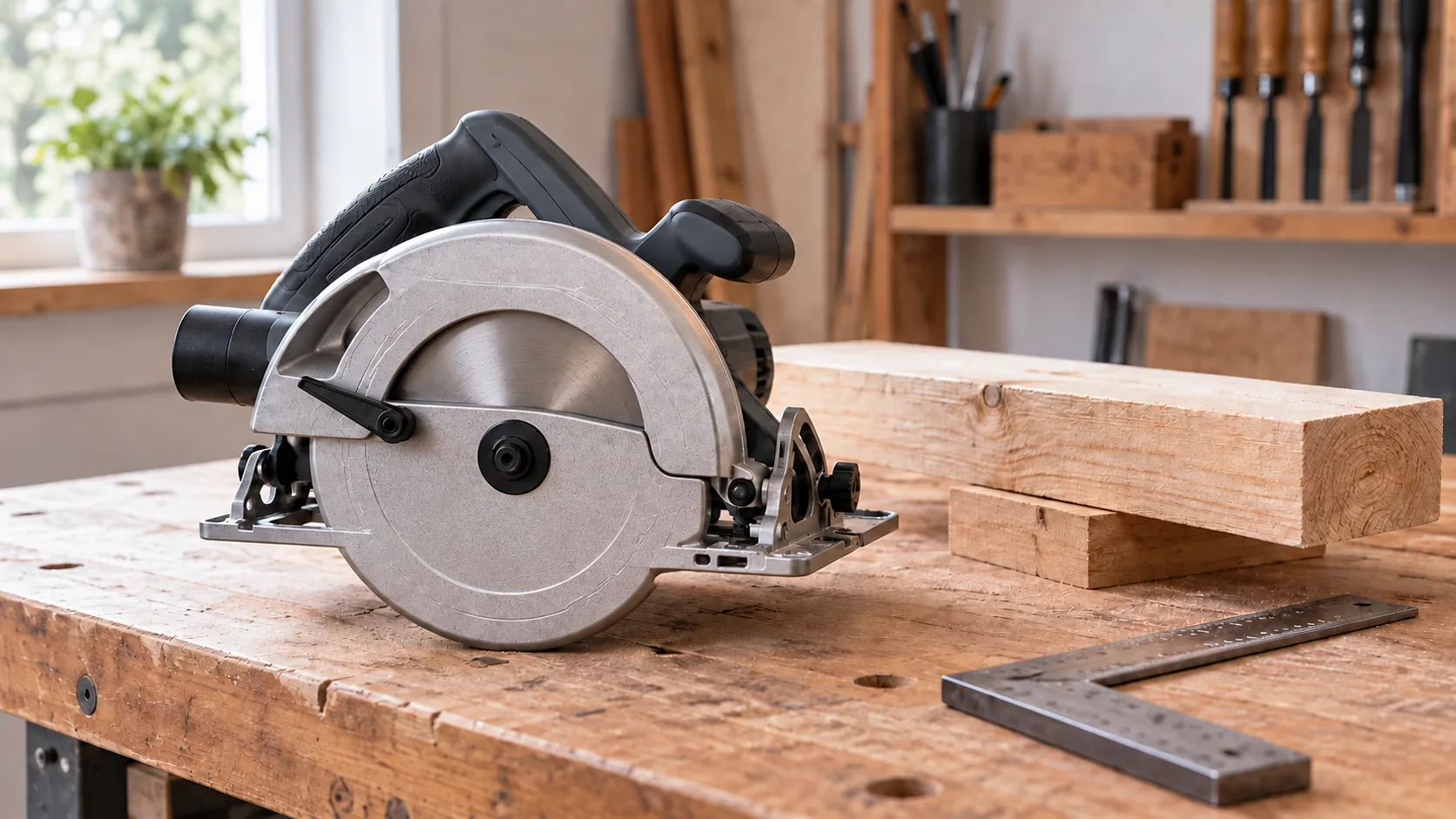
Choose a saw that can make the required cut with a compatible blade and a workable setup. Measure the workpiece thickness, decide whether a cord is practical, then check the exact model's blade diameter, bore, maximum depth, dust connection and included items. A higher wattage or voltage label alone cannot tell you how controlled a saw will feel in your workspace.
The examples below are exact UK manufacturer variants, not a ranking or a cutting test. Bosch's GKS 190 is a 240 V corded saw with a 190 mm blade. Bosch's GKS 18V-57-2 is an 18 V cordless 165 mm saw. DeWalt's DCS565N-XJ is an 18 V cordless 165 mm tool-only variant. The choice depends on the sheet or timber, existing battery system, power access and permitted blade specification. Bosch GKS 190, Bosch GKS 18V-57-2, DeWalt DCS565N-XJ.
What cut depth do you need?
Compare the saw's maximum depth at the angle you plan to cut with the workpiece thickness. Bosch states 70 mm maximum depth for the named GKS 190 and 57 mm straight-cut depth for the named GKS 18V-57-2. DeWalt states 55 mm at 90° for the DCS565N-XJ. These are manufacturer limits, not our measurements. Bosch GKS 190 specification, Bosch cordless specification, DeWalt specification.
Record whether the job is a straight cut or a bevel. The usable depth reduces at a bevel on many saws. Read the exact model's manual for the angle and blade rules. Allow for the work support and the cut route; a maximum depth number is not a setup plan.
How do the named saw variants compare?
The named Bosch corded saw uses a 190 mm blade with a 30 mm bore; its named cordless variant uses 165 mm with a 20 mm bore. The DeWalt listing specifies a 165 mm blade and a 55 mm maximum cut at 90° but does not state a bore on the listing, so verify that dimension in its manual before buying a replacement blade.
Scroll sideways to see all columns on a small screen.
| Exact UK variant | Power and blade | Stated straight-cut depth | Included or setup detail |
|---|---|---|---|
| Bosch GKS 190, 0 601 623 070 | 240 V corded; 190 mm diameter, 30 mm bore | Up to 70 mm | Bosch lists an Optiline Wood blade, parallel guide and hex key for this variant |
| Bosch GKS 18V-57-2, 0 601 6C1 200 | 18 V cordless; 165 mm diameter, 20 mm bore | 57 mm | Listing includes a 24-tooth wood blade and parallel guide; check battery package |
| DeWalt DCS565N-XJ | 18 V cordless; 165 mm blade | 55 mm at 90° | Tool-only listing includes a 24-tooth wood blade, rip fence and dust port; battery and charger are not included |
These are manufacturer facts checked on 3 October 2026. We have not measured weight in use, run time, noise, cut quality or dust capture. Check the exact package because cases, batteries and accessories can differ by SKU. Do not transfer blade dimensions from one variant to another.
Should your first saw be corded or cordless?
Choose corded when a suitable power outlet is available and cord management suits the work area; choose cordless when the correct battery system and charging plan fit the job. The named Bosch GKS 190 is a 240 V tool. The named Bosch and DeWalt alternatives are 18 V tools. The DeWalt DCS565N-XJ page explicitly calls it tool-only and says the battery and charger are absent.
The workpiece and support matter more than an abstract power-system preference. Plan a stable cutting area, an unobstructed cut path and the maker's dust connection. Keep a cord out of the blade path. Check the saw's guard, brake and instructions before using any tool; manufacturer descriptions are not a substitute for a supervised first setup where one is needed.
Which blade fits a circular saw?
Use the blade specifications in the exact saw manual, not the saw's nominal diameter alone. Diameter, bore shape, body thickness, cutting width, permitted speed, material and saw type all matter. In the manufacturer examples above, the Bosch GKS 190 uses a 30 mm bore and the GKS 18V-57-2 uses a 20 mm bore. This difference alone shows why the saw model and manual matter when choosing a replacement blade.
For plywood, check that the blade maker specifies the material and that its diameter, bore, cutting width, body thickness and speed suit the saw manual. A higher tooth count can change finish, but a tooth count alone does not establish fit or safety.
Use our Bosch saw and blade specification chart to see why diameter alone is insufficient. For sheet work, the cut planner lays out parts with grain and blade kerf. If you are connecting extraction, compare exact part numbers in the Bosch hose atlas and use the wood-dust control checklist to plan the work area.
What should you check before a first cut?
Read the manual, inspect the blade and guard, secure and support the work, and confirm the cut path. Set the depth and bevel as the maker directs, use the specified blade and mounting hardware, and connect appropriate dust extraction. Keep hands and the power cord away from the cutting path. The exact instructions for kickback prevention, personal protection and blade changes belong to the saw manual.
The Bosch GKS 18V-57-2 instruction manual warns that a wrong arbour hole size or shape can make a blade run off centre. Your saw may have a different blade mount. Stop and check the correct manual when anything does not match.
How did we research these examples?
We checked the three linked UK manufacturer product pages and the Bosch manual on 3 October 2026. We have not bought or cut with these saws. This guide compares stated specifications and a selection method; it does not name a measured winner. Confirm current product contents and your exact model manual before purchase.