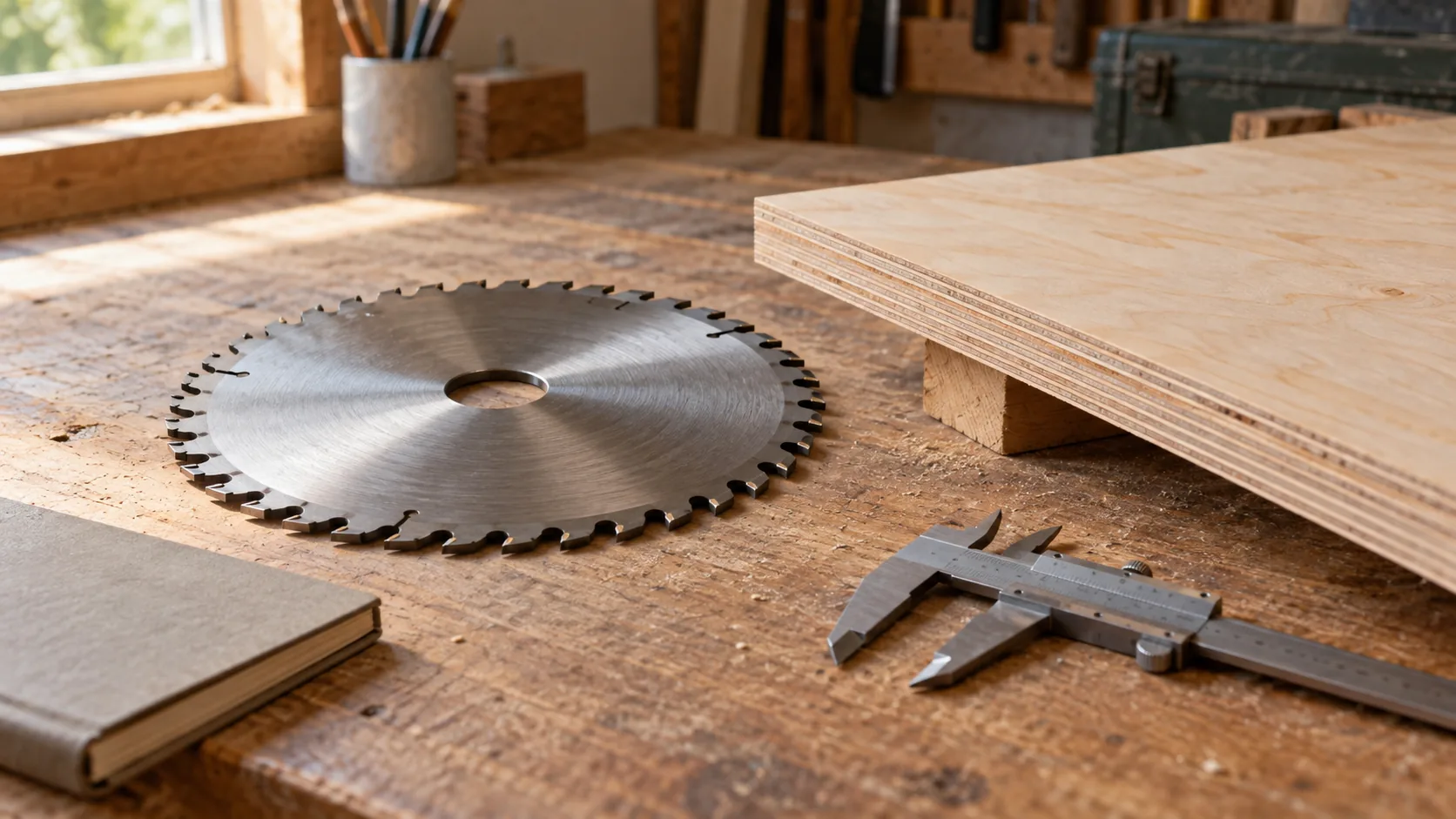
Start with the saw's permitted blade dimensions, then choose a wood blade intended for a clean crosscut. Diameter and bore must match the exact saw instructions. Check blade thickness, cutting width, maximum permitted speed and the saw type before considering tooth count. A 48-tooth label alone does not establish fit or a clean result on your plywood.
Trend lists its CSB/16548B as a 165 mm, 20 mm bore, 48-tooth wood blade for plywood and fine crosscuts. That is a useful specification example, not a universal recommendation. We have reviewed manufacturer pages; we have not made comparative cuts or measured tear-out. Our Bosch saw and blade size chart shows why diameter alone cannot establish compatibility.
Which blade details matter most for plywood?
Read the saw manual for the permitted diameter, bore and blade thickness first. Next check that the blade maker specifies wood or plywood and the correct saw type. Tooth count, tooth geometry and kerf then help narrow the desired cut and the tool's power demands.
Scroll sideways to see all columns on a small screen.
| Specification | Why it matters | Where to verify it |
|---|---|---|
| Diameter and bore | Identify the basic blade size and mounting opening | Exact saw manual and blade SKU |
| Cutting width and body thickness | Need to fit the saw's stated blade requirements | Saw manual and blade specification |
| Material and saw type | A blade's intended application is narrower than its physical dimensions | Blade maker's product page |
| Teeth and tooth geometry | Help distinguish fine wood crosscut blades from rougher-cut choices | Blade maker's stated application |
| Maximum blade speed | Must satisfy the saw manual's speed requirement | Blade marking and saw manual |
The Bosch GKS 18V-57-2 manual warns that an incorrect arbour hole size or shape can cause a blade to run off centre. Check your own saw's manual because a product line can have several variants and packages.
Is a 48-tooth 165 mm blade suitable for plywood?
A 48-tooth 165 mm blade can be a plywood candidate when its maker names that use and the full specification fits the saw. Trend classes the CSB/16548B as a fine-finish crosscut wood blade and lists plywood among the materials for that blade range. Its SKU listing, rechecked 2 October 2026, gives a 20 mm bore, 2.4 mm kerf, 1.6 mm body and 10,000 rpm maximum. Check the marking on the physical blade and the exact saw manual before fitting it. These figures identify one product; they do not establish compatibility with any particular saw. Trend CSB/16548B specification.
DeWalt's DT1086-QZ is another 165 mm, 20 mm bore, 48-tooth wood blade. DeWalt describes applications in natural and man-made wood but does not specifically validate every plywood grade or every saw. Use its UK product specification as a comparison point, then consult the exact saw manual.
How do two named 165 mm blades compare on published specs?
The two named products share 165 mm diameter, 20 mm bore and 48 teeth. The maker pages differ in how clearly they describe plywood as an application. Treat this as a specification comparison only. Our research does not rank cut quality or lifespan.
Scroll sideways to see all columns on a small screen.
| Exact blade | Published dimensions | Maker's stated application | Source |
|---|---|---|---|
| Trend CSB/16548B | 165 mm diameter; 20 mm bore; 48 teeth; 1.6 mm body; 2.4 mm kerf on the current SKU listing | Fine-finish wood crosscuts; plywood named for the blade range | Trend UK |
| DeWalt DT1086-QZ | 165 mm diameter; 20 mm bore; 48 teeth | Natural and man-made wood per the product listing | DeWalt UK |
Do not transfer Trend's cutting width, body thickness or speed limit to the DeWalt blade. Read each product's current marking and full specification. The shared three dimensions do not prove that either blade is approved for a particular saw.
What cutting method helps reduce plywood tear-out?
Use a sharp blade specified for fine wood cuts and support the sheet as your saw manual directs. The blade is only one part of the result. Sheet facing, cut direction, support, feed and blade condition also affect edge quality. Test the intended setup on an offcut of the same board before cutting the finished panel. We have not measured the effect of any individual method and do not claim a percentage improvement.
Disconnect or isolate the saw as its manual directs before changing a blade. Use the blade mounting hardware specified for the tool. Follow the saw and blade makers' instructions for guards, eye protection, dust collection and work support. Do not use this article in place of the exact tool manual.
How can you check blade fit before purchase?
Write down the saw's exact model and part number, then compare every blade requirement in its manual with the full blade SKU. Confirm diameter, bore and mounting shape, permitted blade thickness or kerf, blade speed, material and saw type. Do not infer compatibility from a matching diameter or a reduction ring.
Our Bosch circular saw blade size reference contains a downloadable seven-row dataset that separates blades supplied with three named saw variants from four separate catalogue size examples. It is a size-checking reference, not an approval list for swapping blades.
How did we research this guide?
We checked the linked UK Trend and DeWalt listings and the Bosch manual on 28 September 2026. We have not bought either blade, cut plywood with them, inspected current stock, or tested fit on a named saw. Product specifications can change. Verify the product marking and current manual before purchase or installation.